Ear Training — User Manual
What is Ear Training?
Mazmazika's Ear Training helps you develop a musical ear — the skill of recognising notes, intervals, chords and scales just by listening. You play short audio questions, choose what you heard, and get instant feedback on an interactive piano. It works for both relative pitch (hearing the relationship between notes) and perfect pitch (naming notes on their own).
Everything is gamified with levels, a Progress dashboard, Achievements and Leaderboards, so you can practise a little every day and watch your ear improve.
Who can use it
- Guests (not logged in): try a few free questions in Study Mode.
- Free accounts: unlimited Study Mode and Quiz Mode up to the early levels.
- Pro subscribers: all levels in Quiz and Challenge modes, plus progress tracking, achievements and saved settings.
The trainer at a glance
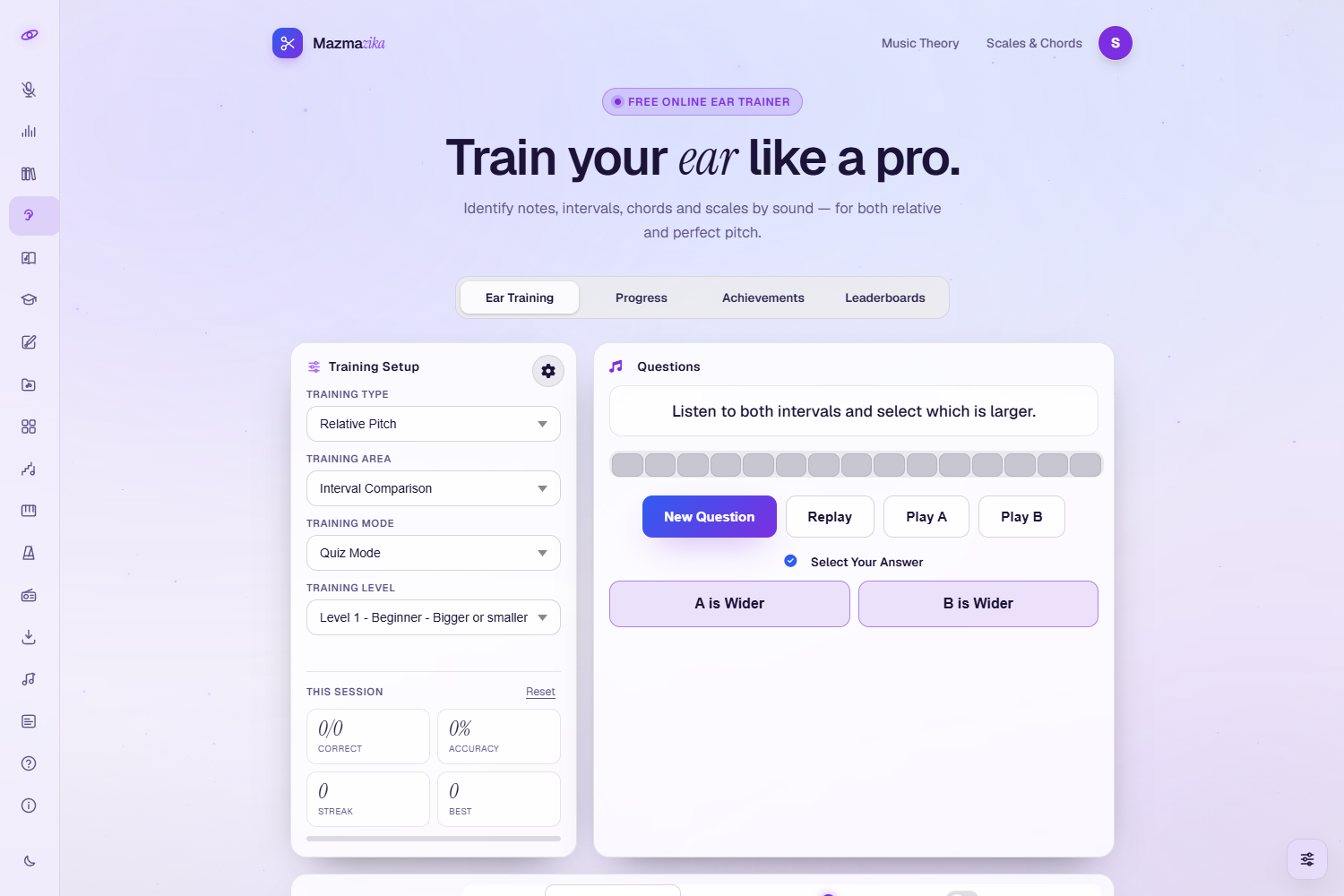
Open Ear Training from the sidebar. Below the hero is a tab bar — Ear Training (the trainer), Progress, Achievements and Leaderboards. The trainer itself has three parts: the Training Setup card (choose what to practise), the Questions / answer area, and the interactive piano at the bottom.
Setting up a session
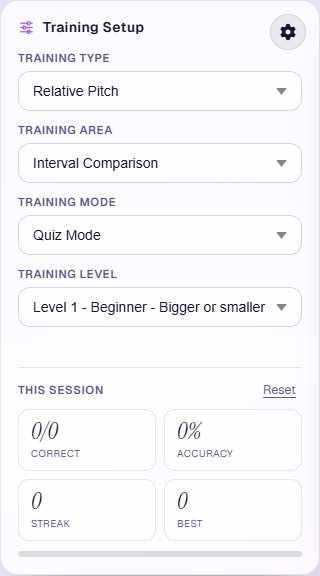
Everything you choose for a session lives in the Training Setup card on the left — pick a Type, an Area, a Mode and a Level, fine-tune with the gear, and watch your This Session stats build as you answer. The next five steps walk through each choice.
Step 1 — Choose a Training Type
In Training Type, pick how you want to train your ear:
- Relative Pitch — recognise the relationship between notes (intervals, chords, progressions, scales). The most useful skill for most musicians.
- Perfect Pitch — recognise individual notes on their own, with no reference.
Step 2 — Choose a Training Area
The Training Area list changes depending on the type you picked.
Relative Pitch areas
| Area | What you practise |
|---|---|
| Interval Comparison | Hear two intervals and decide which is larger |
| Interval Identification | Name the interval you hear (Unison → Octave) |
| Chord Identification | Recognise the chord type (major, minor, diminished, 7ths…) |
| Chord Progression Identification | Identify common progressions (e.g. I–IV–V) |
| Chord Inversion Identification | Tell root position from 1st/2nd inversions |
| Scale Identification | Recognise scales (major, minor, modes…) |
Perfect Pitch areas
| Area | What you practise |
|---|---|
| Single Note Identification | Name one note played on its own |
| Multiple Note Melodic Identification | Name notes played one after another |
| Multiple Notes Harmonic Identification | Name notes played together (a chord) |
| Three Notes Identification | Click the 3 notes you heard on the piano |
| Scale Identification | Recognise the scale being played |
Step 3 — Choose a Training Mode
- Study Mode — free practice with built-in lessons and instant feedback. The best place to start and explore.
- Quiz Mode — structured levels with a fixed set of questions and scoring. Pass a level to unlock the next.
- Challenge Mode — compete live with other players. Create a channel as host, or enter a Channel ID to join someone else's.
Step 4 — Pick a Level
Use Training Level to set the difficulty. In Study Mode you can move freely between Beginner → On Track → Mid-Way → Expert → Master. In Quiz Mode the list shows the structured course levels for the area you chose. The Training Setup card also shows a live This Session read-out of your accuracy and answers as you go.
Step 5 — Fine-tune with Settings (optional)
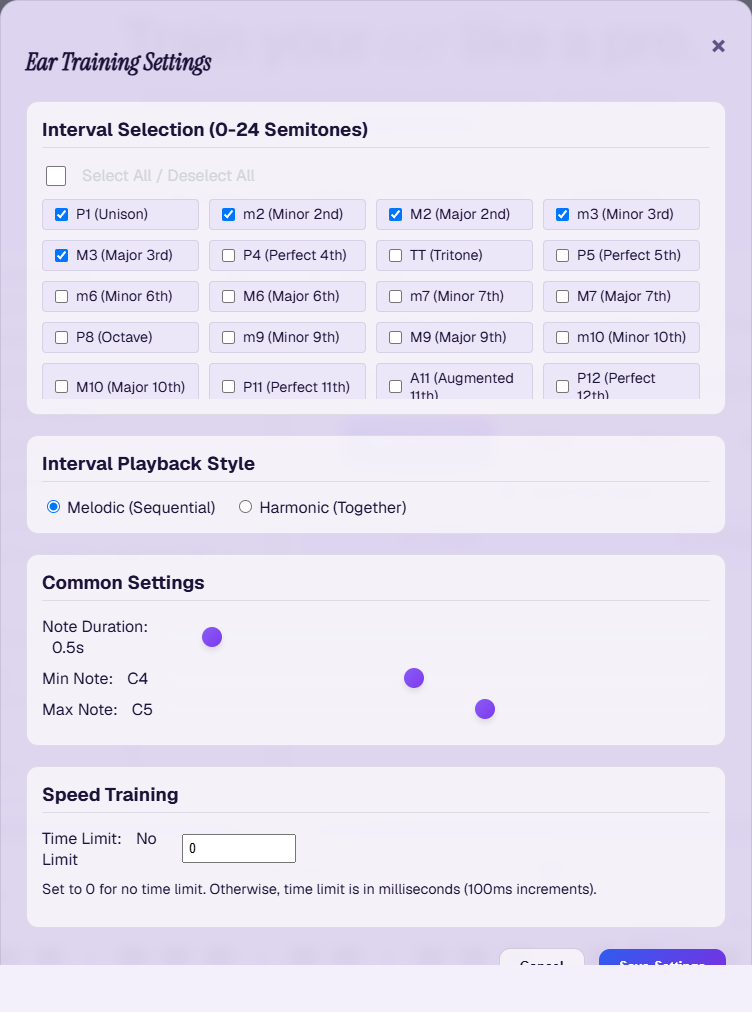
Open Ear Training Settings (the gear on the Training Setup card) to tailor a session — choose exactly which intervals, chord types or scales appear, set the note range and note duration, switch between Melodic (one after another) and Harmonic (together) playback, and add a Speed Training time limit. Save your settings to apply them.
Answering questions
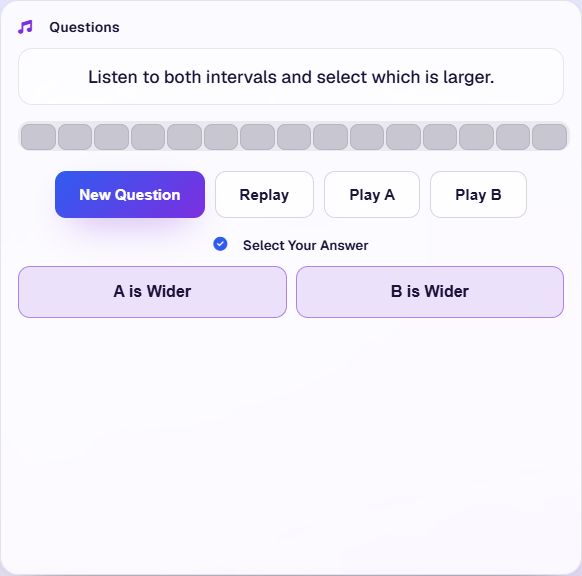
Once you start, the Questions panel tells you what to do and Select Your Answer shows your choices.
The controls
- New Question — play a fresh question. (The first click also turns the sound on.)
- Replay — hear the same question again, exactly as before.
- Play A / Play B — in Interval Comparison, hear the first or second interval on its own.
- Answer buttons — tap the option you think is correct.
- Progress bar — shows how far you are through the current quiz.
Visual feedback on the piano
After you answer, the piano shows coloured circles so you can see exactly what was played:
- Green — the correct note(s).
- Red — your wrong choice (shown next to the green correct answer).
- Blue — the bass note, when practising chord inversions.
The piano & sound controls
The keyboard at the bottom plays along with every question and shows the feedback. You can:
- Instrument — choose the sound (Grand Piano, Analog Synth, Electric Guitar and more).
- Volume — set the playback level.
- Show Keys — turn note labels on the keys on or off.
- Connect MIDI — plug in a MIDI keyboard (Chrome or Edge) to play and answer on real keys.
- Click keys — play notes yourself, and (in some areas) click keys to enter your answer.
Study Mode lessons
In Study Mode the middle of the page shows short lessons — explanatory text and supporting media (image, video or musical notation) — with Previous and Next buttons and a lesson picker. Use these to learn the theory behind each area before you test yourself in Quiz Mode.
Track your progress
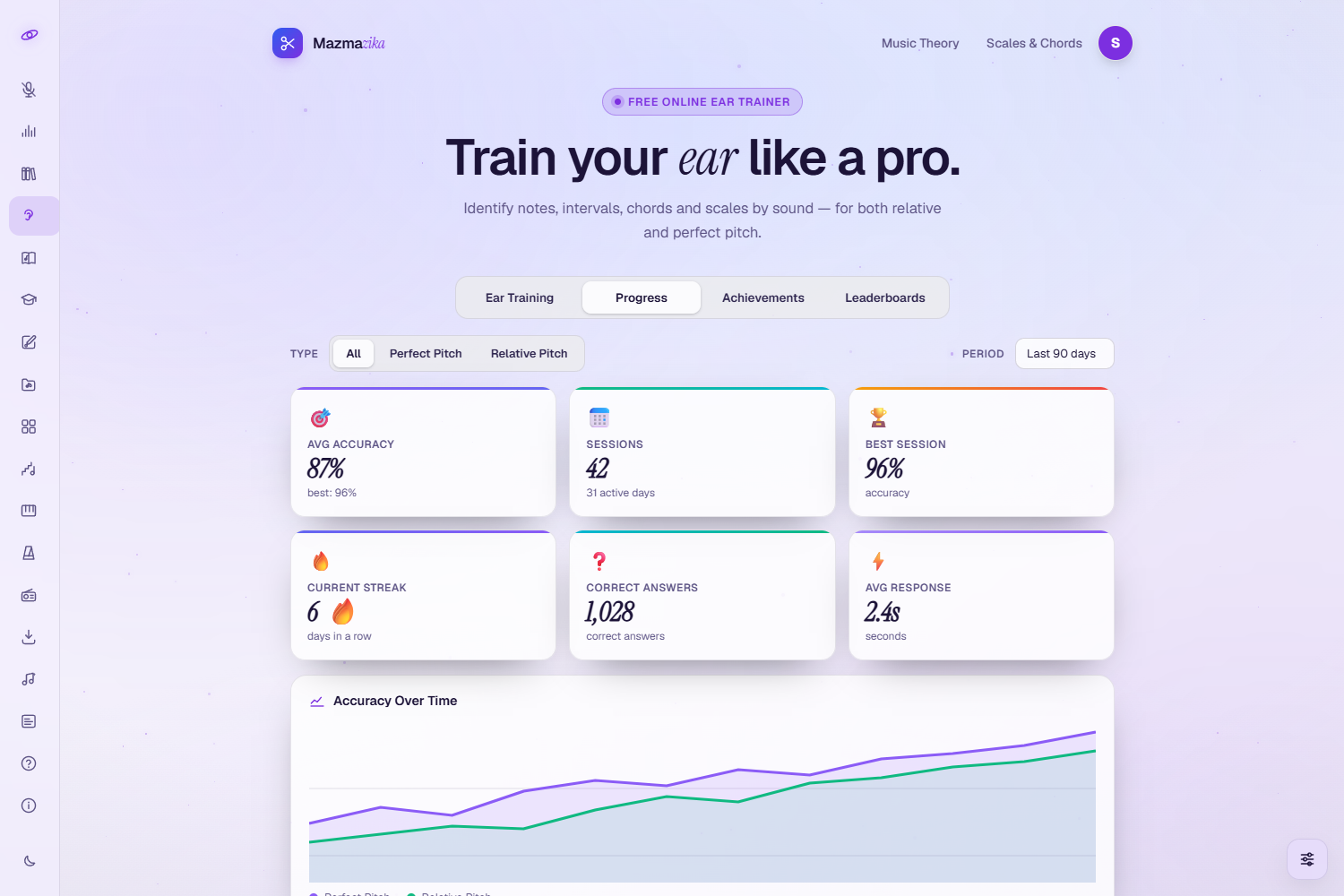
When you're logged in, your practice is saved and surfaced in three tabs above the trainer.
Progress
A dashboard of your accuracy, sessions, streak and response time over time, with charts and a Type filter (all / perfect pitch / relative pitch).
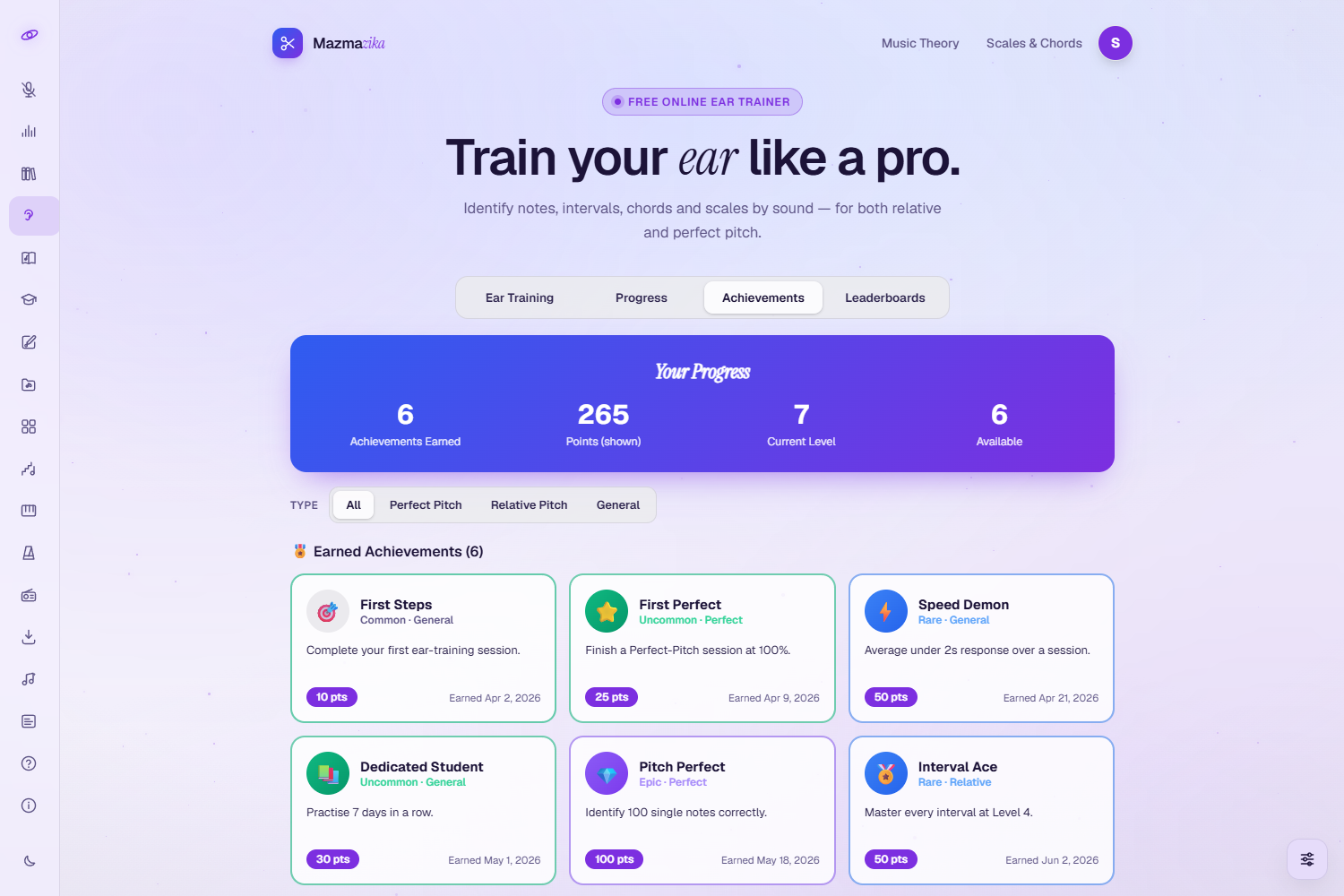
Achievements
Badges you earn as you hit milestones, with a "Your Progress" summary of achievements earned, points and your current level.
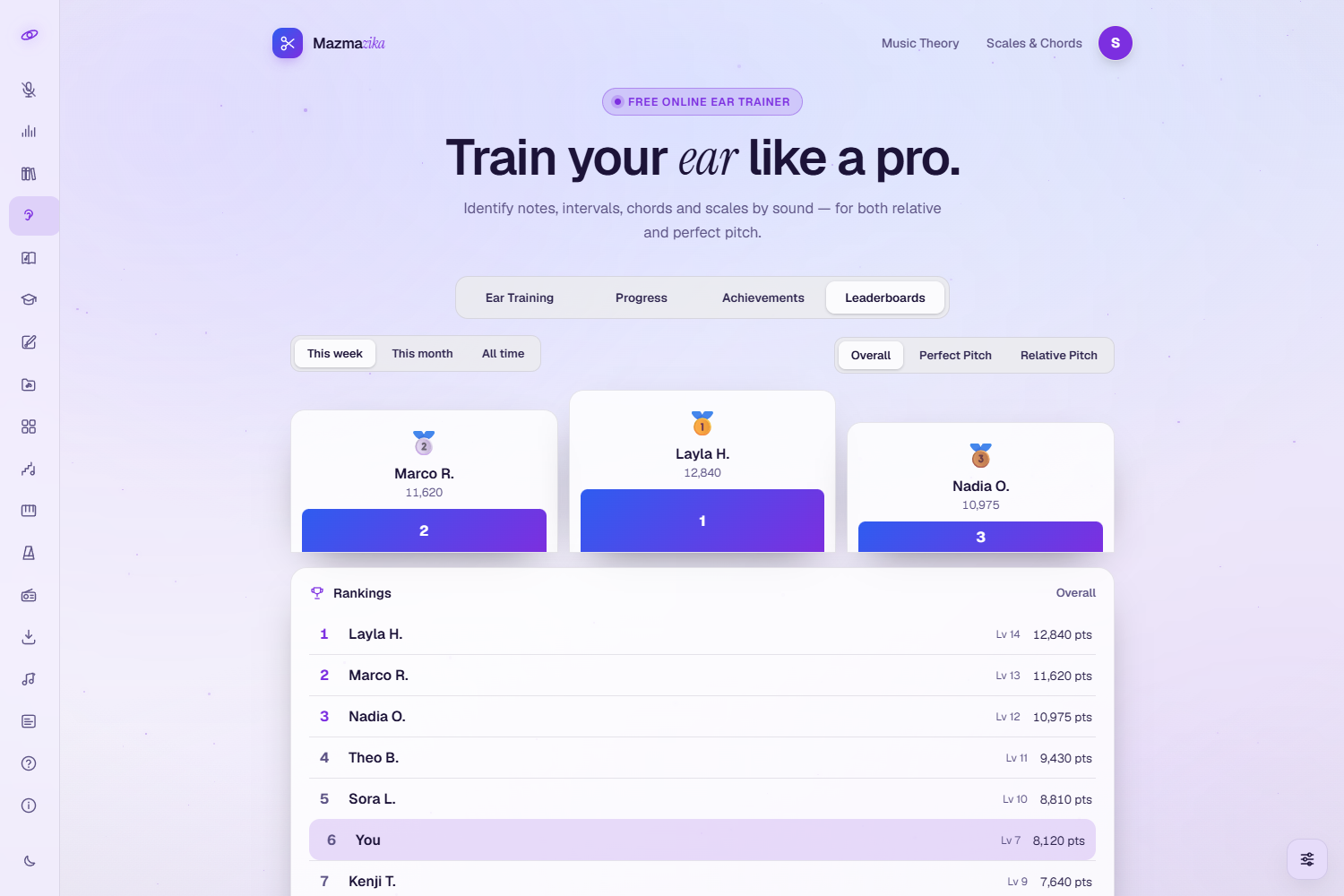
Leaderboards
See how you rank against other players, filtered by time (this week / month / all time) and type (overall / perfect / relative). Your own row is highlighted.
Daily practice builds a streak — a little every day is the fastest way to improve.
Tips for better ear training
- Start in Study Mode to get comfortable with the sounds before taking quizzes.
- Use Replay freely — there's no penalty for listening again while you learn.
- Practise a little daily. Short, frequent sessions beat occasional long ones.
- Begin narrow. Train a few intervals or chord types first, then add more in Settings.
- Sing it back. Humming what you hear strengthens recognition.
Troubleshooting
- No sound? Click anywhere on the page (e.g. New Question) first — browsers only allow audio after you interact. Also check the Volume slider and your device volume.
- Trial limit reached. Guests get a few free questions; register (free) for unlimited Study Mode.
- A level is locked. Free accounts can use Quiz Mode up to the early levels; upgrade to Pro for all levels.
- The piano looks cut off on mobile. The keyboard scrolls sideways — swipe it to reach more keys.
Related tools
Want to hear isolated parts of a real song to train along with? Use the Vocal Remover to split a track into stems. Curious about a song's chords? Try the Chord Analyzer. Keep time while you practise with the Metronome.